Interview with Sugey Cruz and Greg Poppa
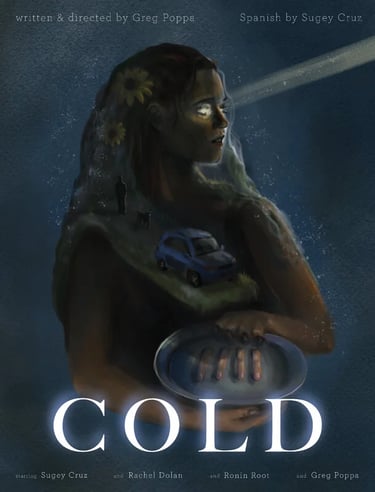
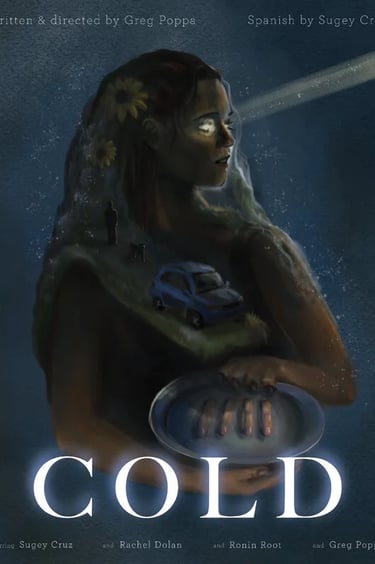
Cold tells the story of Carmen, a Latina woman who wakes up in Purgatory and is given 1,000 days to fix the vehicle in her driveway or spend the rest of her life lost to time. Throughout the film Carmen must battle her harsh environment, isolation and her rapidly declining mental and physical health. Cold is a story of depression, loss and trauma re-lived on repeat day after day after day. As such we want the audience to feel Carmen's frustration and pain while on the hamster wheel of despair. Cold explores the pain of losing a child to suicide and a mother's struggle to move on.
2/6/20267 min read
First of all we would like you to introduce yourself so that we can introduce you to our audience. Who are you? How long have you been making films?
We’re Sugey Cruz and Greg Poppa, independent filmmakers and creative partners passionate about telling stories that feel both cinematic and deeply human.
We’ve been making films for several years, building projects from the ground up — often as period pieces. Our work is rooted in character, emotion, and community, and we love creating films that connect audiences to something meaningful, whether that’s the past, a forgotten perspective, or a shared experience.
And now we talk about your project. What the audience will find?
Audiences will find that “Cold” is a film that’s immersive, emotional, and grounded in authenticity.
Our project offers more than just entertainment — it’s an experience. It explores human resilience and relationships all through intimate storytelling and a cinematic lens. Viewers can expect strong performances, rich atmosphere, and a story that stays with them long after the credits roll.
Were you inspired by any other movie to make the film?
Yes — we’re always inspired by films that combine scale with intimacy.
We were inspired by movies like Annihilation, The Lobster, and Raw, that can feel immediate when it’s told through personal stakes. We’re drawn to stories that balance epic backdrops with deeply human moments, and that influence definitely shaped the way we approached this film.
And now we would like to know about your cinematographic preferences:
For Cold we really wanted to focus on Carmen’s state of mind and her disconnect to the anyone or anything around her signifying her disconnection to life itself. We did this by putting Carmen in a lot, almost exclusively close ups, when Carmen moves, we move with her and when Carmen is dealing with either Armando or Samuel she is generally as far away from them as she can be. One of only two beings that she is really drawn to is her daughter Daniella and the deer carcass in the shed that represents Daniella and in those moments it was extremely important to be up close and personal with Carmen.
What does cinema mean to you?
Cinema is empathy in motion. It’s one of the most powerful ways to step into someone else’s world — to feel what they feel, to see through their eyes, and to understand lives outside our own. For us, cinema is both art and connection.
Cinema utilizes multiple forms of art to tell the story, scoring, music, color, movement, photography, acting, SFX, VFX etc all in service of the story. When Carmen has her breakdown we were inspired by the Nine Inch Nails Song Everyday Is Exactly The Same to create a dizzying spiral for her to go into that is caught and accentuated by our steadicam movement.
What was the first movie you remember seeing?
Sugey: I grew up watching a lot of films from Scarface, The Godfather trilogy, and even The Exorcist but probably the first one that I truly remember fully is a slightly more age-appropriate one—Who Framed Roger Rabbit. I loved the mix of comedy, adventure, animation and just pure fun in storytelling. It is definitely a cross-genre trait I’ve adapted into my work.
Greg: The films I remember vividly as a child most are probably Tim Burton’s Batman, Aladdin, The Lion King and Free Willy. My dad tells the story of how I wore out two copies of Batman on VHS as a 3 year old haha. As I got older in my teen years the film that really stood out and caused my “Wakeup” moment was definitely Fight Club. I discovered that film around the same time I was delving into the music of the 90s and much like Nirvana, Soundgarden and the Smashing Pumpkins, something about Fight Club captured me. It was one of those films that feels like it’s talking directly to your angst and displacement in the world and your want for control and destruction of the system.
Which movie is the best for you?
Sugey: It’s impossible to choose just one, but the films I consider “the best” are the ones that take risks.
La La Land is emotionally honest and visually musical, Fight Club is raw and unpredictable, Jaws is perfectly constructed tension. The best films are the ones that stay with you because they dared to be different.
Greg: Fight Club has stood the test of time for me as my favorite film. Other films I would have way up there are There Will be Blood, No Country for Old Men, The Godfather 1 & 2, Taxi Driver, Psycho, The Master honestly almost anything by the Coen Brothers and David Fincher and lots of Jim Carrey haha For me a great film is not only a great for its generation but lasts for generations to come.
What do you think a movie must have as an essential ingredient?
Sugey: I’m drawn to cross-genre cinema — films that don’t stay in one lane.
I love when a movie can be romantic and tragic, thrilling and funny, grounded and surreal. The films that excite me most are the ones that blend styles and keep the audience slightly off balance in the best way.
Greg: Story. If you don’t have a good or great story it doesn’t matter how beautiful you dress the set, what kind of camera you use, who your actors are, how witty and biting your dialogue might seem if your story stinks your film will stink.
Your favorite actor or actress?
Sugey: My favorite actress is Helena Bonham Carter, and my favorite actors are Ryan Gosling and Gary Oldman. They’re all performers who feel fearless — they don’t just play roles, they transform, and they’re willing to take creative risks that make every character unpredictable and memorable.
Greg: I consider Daniel Day-Lewis to be the greatest actor of all time. His ability to fully disappear into each of his roles, physically, vocally and emotionally is something I aspire to as an actor.
Other actors I admire are Gary Oldman, Robert DeNiro, Kate Winslet, Cate Blanchett, Tilda Swinton, Ralph Fiennes, Andy Serkis, Sam Rockwell, Tom Hardy and Michael Shannon. I’m sure I’m missing a bunch but these are the ones who truly inspire me and make me love the craft.
What qualities do you see in that actor/actress to have such consideration. What do you like most about them?
Sugey: What I admire most is their ability to evolve. Helena Bonham Carter can move from eccentric to heartbreaking with total authenticity. Ryan Gosling has this incredible subtlety — he can carry an entire emotional world with restraint, but also jump into something stylized like a musical or an offbeat drama. And Gary Oldman is one of the ultimate chameleons — he disappears into characters so completely that you forget you’re watching an actor at all.
They all share a willingness to take risks, to stretch beyond what’s expected, and that’s what makes them so inspiring.
Greg: I sort of answered this above but I love an actor who can disappear into roles to the point where you don’t even realize who you’re watching until the credits roll. I remember watching Robert Eggars “Nosferatu” and being shocked to see that Bill Skarsgard was played Count Orlok. That a bit of an extreme example since his prosthetics were so heavy but his vocal work, his physicality and his overall presence jumps off the screen in a way that very few performances do.
A good movie has to...
Sugey: A good movie has to take you somewhere unexpected. It should make you feel something — joy, fear, nostalgia, shock — and ideally it should shift tones in a way that feels bold but intentional. The movies I love most are the ones that feel alive.
Greg: A good movie has to tell a good story and entertain. A great movie tells a good story, entertains, has stellar performances, captivating cinematography, production design etc etc. There are very few truly “great” films because it is really hard to nail every aspect of cinema which makes creating a film so much fun.
What genre of cinema do you prefer?
We’re especially drawn to historical drama/fiction and character-driven stories with a bit of a bent towards purposeful body horror.
We love films that explore real moments in time while focusing on the individuals inside them — the people history books often overlook and the grittiness of life.
How do you define yourself professionally?
We define ourselves as independent storytellers and filmmakers who build projects with purpose. We’re hands-on creators — producing, directing, shaping every detail — and we care deeply about authenticity, collaboration, and telling stories that matter.
What movie have you seen most often
Sugey: The movies I’ve probably watched the most are the Harry Potter series and The Hunger Games series — I’m drawn to stories with immersive worlds, strong character arcs, and that sense of fate and survival.
But I also return often to films like Spaceballs and Muppet Treasure Island, because I love storytelling that doesn’t take itself too seriously. Those films remind me that cinema can be adventurous and emotional, but also clever, ridiculous, and joyful.
That balance — epic stakes mixed with humor and heart — is something I really connect with and find inspiring.
Greg: If we’re talking total times since I was a little kid probably Batman or Aladdin. Since I’ve been watching films truly for myself, again probably Fight Club. I typically watch it every year at some point and try to pick up different aspects that I appreciate now and nuances in Norton, Pitt and Carter’s performances.
What topics are the most inspiring for you?
Sugey: I’m most inspired by stories that live at the intersection of emotion, tension, and transformation. I love narratives where characters are forced to evolve — where love, fear, ambition, survival, or identity push someone into becoming something new. That’s something you see in films as different as La La Land, Fight Club, The Hunger Games, or even Harry Potter: characters growing under pressure in worlds that feel larger than life.
I’m also drawn to stories that blend tones — films that can be romantic and haunting, thrilling and funny, grounded and stylized. And ultimately, what inspires me most is cinema that takes risks: bold performances, unexpected genre shifts, and stories that balance heart, spectacle, and humanity all at once.
Greg: I love a good character study, something that looks at niche subjects and explores characters in that world. I think the Coen Brothers do the best job of this especially in films like Fargo and Inside Llewyn Davis.