Interview with Lulu Oparanozie
I’m a dark fantasy writer and artist, from New York, and my stories are often influenced by mythology and surrealism, but my work has spanned several genres. My call to storytelling began young, as early as I was able to dream; My writing and abilities as a storyteller really started taking shape in Undergrad, but got infinitely better once I graduated and began my full-time film career
3/3/20264 min read
Who is Lulu Oparanozie and how did the passion for creating begin?
I’m a dark fantasy writer and artist, from New York, and my stories are often influenced by mythology and surrealism, but my work has spanned several genres. My call to storytelling began young, as early as I was able to dream; My writing and abilities as a storyteller really started taking shape in Undergrad, but got infinitely better once I graduated and began my full-time film career.
Can you tell us a bit about your previous work?
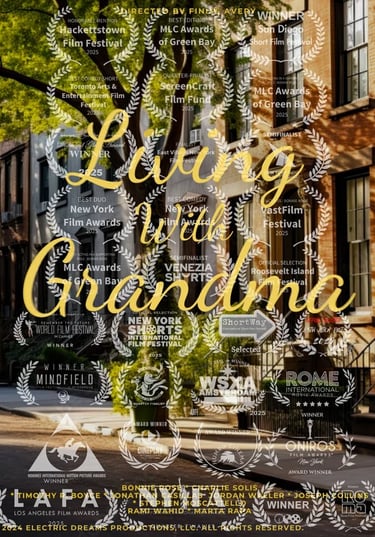
I have been a Script Supervisor and Staff Writer in my more recent projects including, “Living with Grandma,” but my background and strength is in Development as a Fantasy Screenwriter and Creative Producer. I started my career in sketch comedy production, shifted gears into horror and drama, and now I’m back in the comedy world with Electric Dreams Productions.
“Living With Grandma” feels deeply personal yet refreshingly humorous. What was the spark that first lit the idea for you, a real-life encounter, a story you heard, or perhaps your own fascination with the bond between generations?
The Head Writer for “Living with Grandma,” was our incredible Producer and Director, Finise Avery. This short film was influenced by the real-life story of Louis Cangiano, one of the writers on this team. Gambling, alcoholism, and hitting rock bottom are central to this story, while still being funny and heartwarming. We wanted to film a story that would reach every generation.
How did collaborating with Director Finise Avery and Brendan Jelloe shape the emotional and comedic rhythm of the script? Were there any creative clashes or “aha” moments that changed the story’s direction?
I enjoyed working with the entire crew, from the team of Execs to our PAs. Finise and I had met through a mutual friend in film and we’ve been collaborating since. Her filmography is impressive and her vision was the most integral to the rhythm of the script. She knows how to balance funny moments with tender moments in the same scene. While I don’t think there were any “aha” moments in development, there were several really good writer’s room sessions of course.
You co-wrote Living With Grandma with an international team. What was it like blending voices from different cultural and creative backgrounds into one cohesive story?
Our team of writers all have different stories and backgrounds, two of us women, and the other two men. It felt normal to have different backgrounds, both culturally and creatively. I think that’s what NY is about, where the artists across the world come to create and collaborate. Jacob Skiles is a great, upcoming writer, who worked with Louis and Finise as a co-writer and scribe. The entire team saw the potential in this project from the beginning.
You’re known for writing strong female and Latinx representation in mythological or fantastical worlds. How did that creative DNA seep into Living With Grandma, which is a more grounded story?
I’m sure that my fantasy writing has shaped the way I structure tone, beats, visuals, and I think that my style may have added a touch of whimsy. Even as a more relatable and grounded story, I still find the fantastical in the ordinary things. Grandma Rose to me, is somewhat of a flighty, yet guiding mythic figure in this film who reminds me so much of otherworldly oracle-like characters in my fantasy scripts.
What was the most challenging scene to write, emotionally or structurally?
Comedy as a whole is actually rather difficult to write, structurally. It’s hard to capture the energy, timing, and wittiness of a good joke told in real time. I’m someone who doesn’t like to force a joke, and the team is the same. We had written several different options for sections of dialogue, and re-worked some lines after table reads as well. So, making the comedic moments feel natural, and workshopping until the scene felt right, was the biggest challenge.
In future projects, do you plan to explore similar genre intersections, or are there other genres you're eager to explore ?
I absolutely plan to continue working with Electric Dream Productions on several other projects. I don’t think we are restricted to a specific genre but we have been loving comedy and drama. I have separately been working on my own stop-motion script and I plan on continuing to focus in on fantasy projects. If I could direct a film of mine with Guillermo del Toro, that would be the dream.
What advice would you give to emerging writers trying to find their authentic voice while still appealing to wider audiences?
I was given some really good advice from a writer in the WGA East, who I met out on the picket lines in NYC. He said, “don’t say that you’ll write any kind of story for anyone willing to pay. Write what you are most passionate about and get really really good at it.” I think you’ll always appeal to a wide audience when you’re authentic and enjoy what you’re writing. So, I would say, force yourself to write and invest in your personal writing time. Put it on your schedule and treat it will as much respect as you would any job. Show up for your writing, be honest about what you want in film, network to the Gods, and get your friends together to make a movie. We write movies to get them off paper, so don’t wait for a huge corporation to come by to start producing your own films.